

Your child’s dentist just found a cavity, and now they’re deciding what treat is most appropriate: a filling or a crown. For many parents, these two treatments sound interchangeable, but they serve very different purposes depending on how advanced the decay is and which tooth is involved. The right choice can protect your child’s smile for years to come, and understanding the difference makes navigating that conversation with your dentist a whole lot easier.
At University Pediatric Dentistry in Charlotte, NC, Dr. Funny and her team approach every cavity with a thorough evaluation before recommending any treatment. With over 18 years of experience caring for children’s smiles, Dr. Funny tailors restorative and preventive services to each child’s unique needs, balancing long-term oral health with comfort and function. Families across the Charlotte area trust our office to make those decisions thoughtfully and transparently. Whether your child needs a simple filling or a full-coverage crown, our team takes time to explain every step of the process.
How Dentists Evaluate a Cavity
When Dr. Funny examines a cavity, the first priority is determining how much of the tooth structure has been affected. A combination of a clinical exam and digital X-rays gives our team a clear picture of the decay’s size, location and depth. From there, the decision between a filling and a crown comes down to a few key factors that the American Academy of Pediatric Dentistry addresses in its best practices for pediatric restorative dentistry, which guides how pediatric dentists evaluate and restore primary and permanent teeth in children and adolescents.
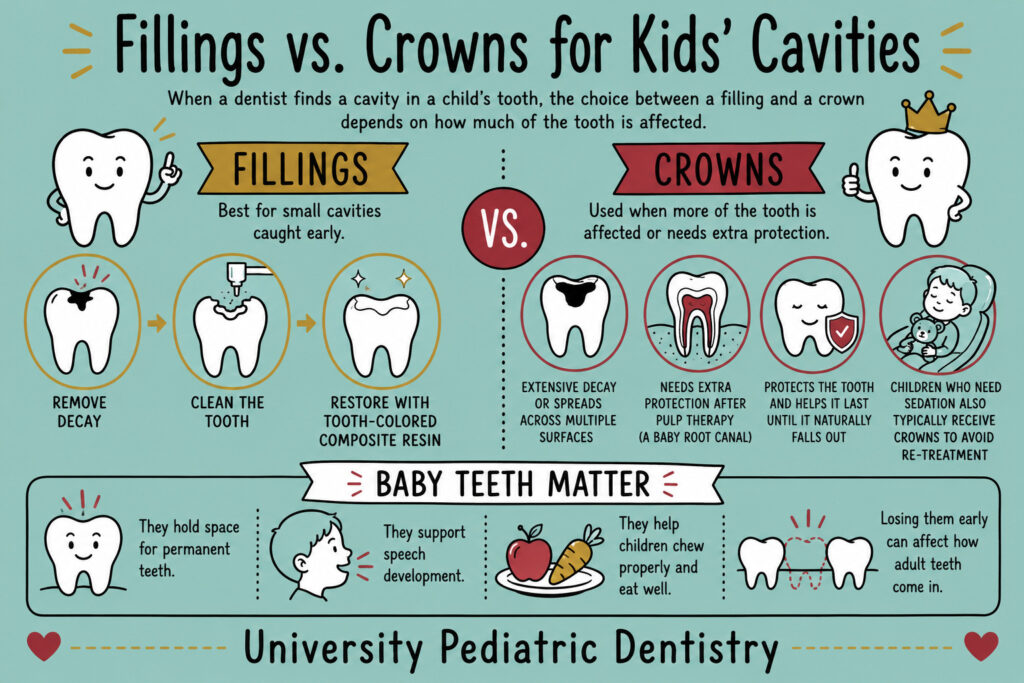
The extent of decay matters most. A small or moderate cavity that affects a limited portion of the tooth may be treatable with a filling, which removes the decayed tooth structure and fills the space with composite resin. However, when decay is more extensive or has compromised the structural integrity of the tooth, a filling alone may not provide enough support or durability. In those cases, a crown offers full-coverage protection that a filling simply cannot match.
When a Filling Is the Right Choice
Fillings work well for cavities that are caught early and have not spread to multiple surfaces of the tooth. At University Pediatric Dentistry, we use tooth-colored composite resin to restore decayed teeth while maintaining a natural appearance. This material bonds directly to the tooth structure, which helps preserve more of the healthy tooth than older materials require. If the cavity is small and the surrounding enamel is sound, a filling is often the most conservative and effective approach.
This is one of many reasons we emphasize preventive care for children of all ages. Catching decay early during a regular visit gives us more options and allows for less invasive treatment overall.
When a Crown Becomes Necessary
A crown is recommended when more of the tooth’s structure is at stake than a filling can reliably restore. Several specific situations consistently call for full-coverage restorations in children.
Extensive Decay and Structural Damage
When a cavity has spread across multiple surfaces of the tooth or when significant tooth structure has been lost, a crown offers the support that a filling cannot provide on its own. For back teeth like primary molars that endure heavy chewing pressure daily, stainless steel crowns are a durable and reliable option. For front teeth where appearance is more of a priority, tooth-colored alternatives may be available and worth discussing with Dr. Funny during your visit.
After Pulp Therapy
When decay reaches the inner nerve of the tooth, pulp therapy (often called a baby root canal) may be needed before the tooth is restored. Following pulp therapy, a crown is almost always placed to protect the treated tooth and preserve its function. Our aesthetic dentistry options include both stainless steel and tooth-colored crowns to accommodate different needs and preferences.
Children Who Need Sedation
For children who require sedation to complete their dental treatment, crowns are often the preferred restoration even for moderately sized cavities. Because re-treating a tooth is significantly more difficult outside of a sedation, placing a crown in a single visit reduces the chance that the tooth will need additional work later on. Our sedation dentistry team prioritizes efficiency and comfort, and choosing the most durable restoration the first time around supports both goals.
The Role of Baby Teeth in Your Child’s Development
Some parents wonder whether it is worth treating cavities in baby teeth since those teeth eventually fall out. Primary teeth hold space for permanent teeth, support proper speech development and allow children to chew comfortably. Leaving decay untreated in a baby tooth can lead to pain, infection and early tooth loss, all of which can affect how adult teeth come in. Whether the treatment is a filling or a crown, addressing the cavity protects your child’s development and sets a healthy foundation for the years ahead.
Trust University Pediatric Dentistry with Your Child’s Smile
At University Pediatric Dentistry, we are a proud owner-operated practice led by Dr. Funny, a board-certified pediatric dentist with a genuine commitment to making every child feel comfortable and every parent feel informed. Our sensory-friendly environment, experienced team and thoughtful approach to restorative care make us a trusted dental home for families throughout Charlotte and the surrounding communities. We accept Delta Dental and all other PPO plans and also offer flexible payment options including CareCredit, HSA and FSA funds and an in-house membership plan for families without traditional dental insurance.
If your child has been diagnosed with a cavity or is due for a checkup, we are here to help you navigate every step. Contact our office to schedule an appointment and find out which treatment is the right fit for your child’s smile.